
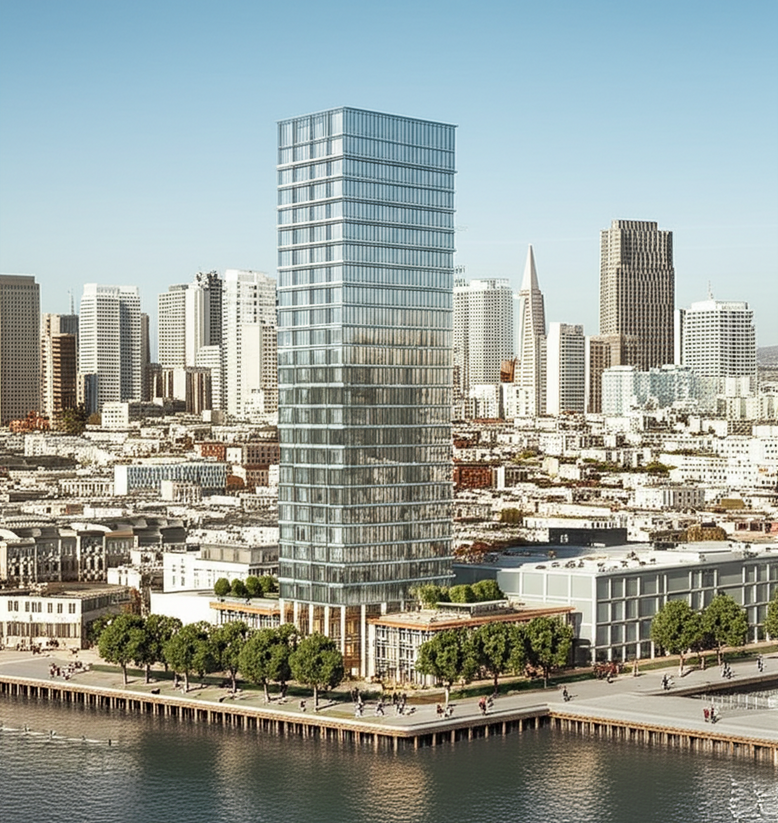
Letters: A 25-story tower in the Marina District? Is this San Francisco or Miami Beach? 🏙️ 🌴
In a city as stubbornly iconic as San Francisco, defying its skyline’s gentle tilt might seem sacrilege. Yet, here we are, watching a 25-story high-rise rise unapologetically in the Marina District – an area where neighbors rather hoard charm and bay breezes than concrete giants. One could easily mistake the scene for Miami Beach, with its unabashed verticality and southerly swagger. But this is not South Florida; this is the city that birthed cable cars and hippies, not flashy condominiums that pierce clouds like an impatient skyscraper’s finger.
Is this the start of an identity crisis, or are we witnessing the natural evolution of a city desperate to house its growing ambitions? The juxtaposition of historic low-rise row homes against a rising tower is a striking antithesis — a dialogue between the city that was and the city racing towards an uncertain future.
The Marina District: Sanctuary of the Past or Launchpad to Tomorrow?
Once a naval air station and, before that, waterweed and mud, the Marina District blossomed post-World War II into a playground for the wealthy and the whimsical. Unlike the Financial District’s steel muscles, the Marina’s heart beats to a softer rhythm of palm-lined streets, 1920s and ‘30s craftsman homes, and a marina filled with boats rather than business suits. The proposal of a 25-story tower here feels like planting a skyscraper in a rose garden — curious, unsettling.
“Inserting a towering monolith into this neighborhood is like attempting to squeeze a skyscraper into a postcard – the frame crumples and the message distorts.”
Critics decry this as an erosion of neighborhood character. Supporters hail the necessity of densification in a crisis of housing scarcity. But when the skyline starts to mimic Miami’s exuberance, it begs the question: has San Francisco surrendered its architectural soul to the siren song of profit? Or is this, instead, a bold embrace of modernist progress?
How Did We Get Here? Housing Crisis Meets Ambition
The reasons for this vertical jump are less about aesthetic rebellion and more about the cold arithmetic of supply and demand. San Francisco’s housing crisis, a beast with citywide reverberations, pushes planners and developers into vertical realms long shunned by local tastes. The metro area has struggled to add supply commensurate with job growth, and the Marina District’s relative openness and waterfront allure make it a prime candidate for ambitious development.
Data speaks volumes: As of 2023, San Francisco’s median home price holds firm above $1.4 million, and the city’s population has seen a recent uptick after years of decline, propelled by tech rebounds—even as affordable housing remains elusive. A 25-story tower means potentially hundreds of units, an injection of homes like rainwater on parched soil.
Yet, this is where subtle irony sneaks in—the very tower designed to ease a housing pinch threatens to unravel the distinct neighborhood fabric residents cherish. Creativity is called for, but so far, the skyline addition looks like a letter of eviction sent to history.
San Francisco vs. Miami Beach: More Than a Height Comparison
Comparing the Marina’s new tower to Miami Beach is more than a quip about palm trees and pastel hues. It points to clashing ethos: Miami Beach revels in sunny excess, unapologetic tourism, and vertical bravado. San Francisco, in contrast, built its legend on hills and human scale, with architecture that whispers stories rather than shouts. The tower’s silhouette against the Bay Bridge evokes a glass monolith cast into a bowl of rustic pottery — an alien shape among fragile tradition.
Miami’s skyline, reminiscent of a high-stakes poker table, flaunts its winnings—luxury towers stacked like chips, glowing like neon signs to night. The Marina’s emerging skyline, by contrast, is more an awkward first move in a game it barely knows. Is it bluffing? Or is it game-changing?
The Human Element: Neighbors, Nostalgia, and Newcomers
It’s easy to treat this as a contest of bricks and glass, but the real battleground is human. The Marina’s longtime residents see their slice of the city shrinking — and not just physically. The neighborhood’s history, once as delicate as the bay fog, risks being overwritten by a towering shadow. Yet, for others arriving in droves—young professionals, artists, inclusively minded families—the new construction signals hope, inclusion, even survival.
Consider the 74-year-old woman who’s watched sailboats replace military hangars, and now watches cranes scraping the sky with a skeptic’s eye. Contrast her with the 28-year-old software engineer for whom the tower is not an intruder, but a necessary nesting spot in a city that’s barely room for dreaming. This human tension—the old city and the new—could be the story behind every window in that towering new block.
What Does It Say About San Francisco’s Future?
When the skyline blurs the boundary between San Francisco and Miami Beach, it’s tempting to see the result as a loss. Yet, it could also be a poignant symbol of a city wrestling with its contradictions. Here lies a place where heritage clashes spectacularly with necessity, where the past and future dance awkwardly under the same fog.
Like the fog itself—thick, enveloping, sometimes obscuring but always present—so too is the city’s identity in flux. We cannot choose a single shape for our city’s silhouette; it must grow, stretch, and prune itself like an ancient tree trying on modern leaves.
San Francisco’s Marina District today stands as a vivid metaphor: a 25-story tower soaring upward, casting shadows but also offering perspective. The question isn’t whether this is still San Francisco, or a Miami knockoff — but rather how San Francisco can redefine itself without losing the soul that made it extraordinary. 🌁🏢🛶
Perhaps, instead of fearing imitation, we should consider that every towering glass and steel rise is an untitled letter, sent from the heart of a city unafraid to be complex, conflicted, and messy — like the people who call it home.


